Walk into any well-designed Indian home today, and you will notice something has quietly changed. The plain white emulsion walls that once dominated living rooms are giving way to something far more considered — surfaces with texture, depth, and character. Two finishes are leading this shift: microcement and lime plaster.
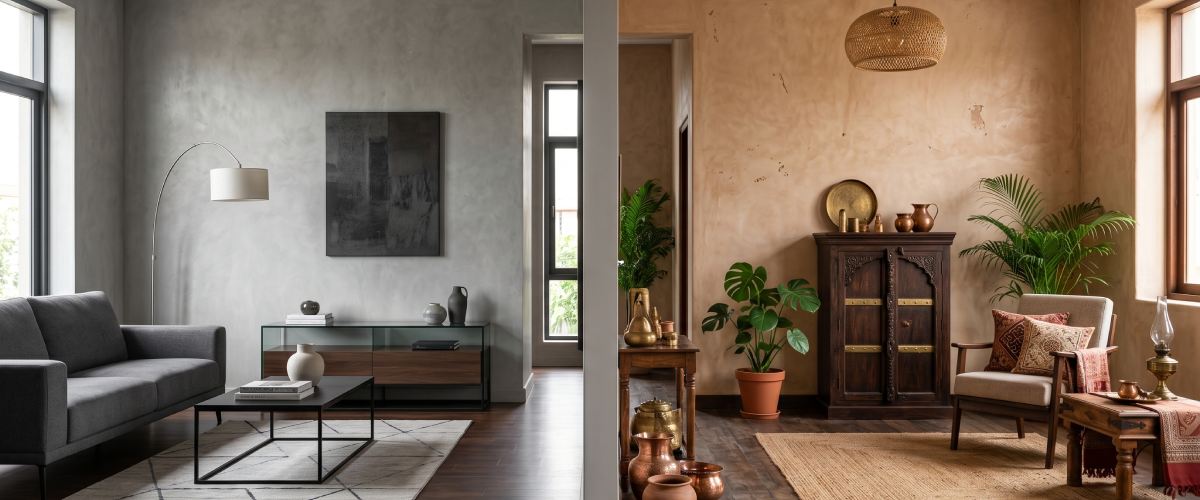
Both look stunning in a mood board. Both are beloved by interior designers. And both come up constantly when homeowners in India are making one of the most important decisions about their space — what goes on the walls.
But they are very different materials, with very different personalities. This guide breaks down everything you need to know before you decide.
What Is Microcement?
Microcement (also called micro-topping or microtopping) is a modern, cement-based coating applied in thin layers — typically 2 to 3 mm — directly over existing surfaces. It contains cement, resins, water-based polymers, and fine aggregates. The result is a seamless, smooth, industrial-looking finish with no joints or grout lines.
Microcement originated in Europe and became popular globally for its ability to create a contemporary, minimalist aesthetic on floors, walls, countertops, and even furniture — all without heavy demolition or thick builds.
It is typically sealed with a polyurethane or epoxy resin to make it water-resistant and durable.
What Is Lime Plaster?
Lime plaster is one of the oldest building materials in the world — and one of the most sophisticated. Made from slaked lime, marble dust, natural aggregates, and sometimes natural pigments, it has been used for thousands of years across India, the Mediterranean, and beyond.
In modern interiors, lime plaster refers to a family of premium finishes, including:
- Venetian plaster — polished, marble-like, luxuriously smooth
- Stucco— subtle stone-like texture with natural depth
- Concrete— a Moroccan lime finish, naturally water-resistant
- Limewash — a matte, chalky, layered effect with a soft antique quality
Unlike microcement, lime plaster contains no synthetic resins. It is a fully mineral, natural material that breathes, ages gracefully, and improves over time.
Microcement vs. Lime Plaster: Side-by-Side Comparison
1. Appearance and Aesthetic
Microcement delivers a clean, industrial look. Smooth, matte or satin, with a consistency that feels precise and contemporary. It suits modern, minimalist, and Scandinavian-inspired interiors. The colour palette tends toward concrete greys, warm beiges, and earthy neutrals, though it can be pigmented in a range of tones.
Lime plaster has an entirely different visual quality — organic, warm, and alive. The surface holds light differently at different times of day, creating subtle movement and depth that no paint or synthetic finish can replicate. Venetian plaster, for example, has a polished luminosity. Limewash has a rustic, layered softness. Concrete looks like natural stone.
2. Suitability for Indian Climate
This is where the comparison becomes particularly important for homeowners in India.
India's climate is not uniform — you have dry heat in Rajasthan and Delhi, extreme humidity in Mumbai, Kerala, and Chennai, and seasonal monsoon swings across most of the country. Your wall finish needs to handle all of this.
Microcement is sealed with a resin-based topcoat that makes it water-resistant on the surface. However, because it is not breathable, moisture that gets behind the wall — from seasonal humidity, poor ventilation, or rising damp — has nowhere to go. Over time, this can cause bubbling, delamination, or surface cracking, particularly in older buildings or coastal cities.
Lime plaster is breathable by nature. This is one of its most critical properties for Indian homes. It absorbs excess moisture from the air and releases it as conditions change, preventing the build-up of dampness inside walls. This makes it particularly well-suited to India's humid coastal regions, homes with older masonry, and any space prone to seasonal humidity swings.
Lime plaster's high alkalinity also makes it naturally resistant to mould, bacteria, and mildew — a genuine advantage in a tropical climate.
3. Durability
Microcement is hard and durable once fully cured and sealed. It handles high foot traffic well on floors and resists light impact on walls. However, the sealant layer is critical — without proper and periodic resealing, the surface becomes porous and stains easily. Scratches can also be difficult to repair invisibly.
Lime plaster is softer than microcement initially, but gets harder over time through a process called carbonation — it absorbs carbon dioxide from the air and gradually turns back into limestone. This means lime plaster walls actually improve structurally with age. Small cracks and chips can be repaired seamlessly because fresh lime bonds chemically with the existing surface. After years, a repaired patch is indistinguishable from the original.
4. Application and Installation
Both materials require professional application — this is not a DIY project for either.
Microcement application involves surface preparation, a primer coat, two to three layers of microcement, and then a sealant. The process is relatively systematic and can be completed in a few days. Because it can be applied over existing tiles, concrete, or plaster without demolition, it is often used in renovation projects to save time and cost.
Lime plaster requires skilled craftsmanship. Each finish type, has its own application technique, drying requirements, and polishing or burnishing process. The work is slower, more labour-intensive, and requires a trained artisan applicator. The result, however, is uniquely handcrafted — no two walls are ever exactly alike.
5. Eco-Friendliness and Health
Microcement contains synthetic resins and polymers. The sealants used are often polyurethane or epoxy-based, which can off-gas VOCs (volatile organic compounds) during and after application. This is not unique to microcement — many modern surface finishes have similar characteristics — but it is worth noting for those prioritising indoor air quality.
Lime plaster is entirely natural. It contains no synthetic binders, no VOCs, and no toxic compounds. It is hypoallergenic, and because it is alkaline, it actively discourages the growth of mould and airborne bacteria. Lime plaster also absorbs CO2 as it cures, making it one of the few building materials that is genuinely carbon-sequestering.
For families with young children, elderly residents, or anyone concerned about indoor air quality — especially in India's increasingly polluted urban environments — lime plaster is the more responsible choice.
Which Should You Choose?
There is no universal answer — but there is usually a clear answer once you know what matters most to your project.
Choose microcement if:
- You want a clean, industrial, or Scandinavian-minimalist aesthetic.
- You are renovating and want to avoid demolishing existing tiles or floors.
- The space is primarily a high-traffic floor area.
- You are working to a tighter timeline.
Choose lime plaster if:
- You want a genuinely luxurious, organic, handcrafted wall surface.
- Your home is in a humid city like Mumbai, Chennai, Kochi, or Kolkata.
- You are building or renovating with sustainability and indoor air quality in mind.
- You want a finish that will look better in 10 years than it does today.
- You are working on a premium villa, boutique hotel, or high-end residential project.
For most Indian homes — particularly those in coastal or monsoon-prone regions — lime plaster is the more intelligent long-term choice. It works with the Indian climate rather than against it.
A Note on Combinations
The two finishes do not have to compete. Many well-designed spaces in India use both strategically — microcement on bathroom floors for its seamless, water-resistant quality, and lime plaster on bedroom and living room walls for its warmth, texture, and luxury presence. Used together with intention, they complement each other beautifully.
Final Thoughts
Both microcement and lime plaster are premium finishes that will transform your space far beyond what conventional paint or texture coatings can offer. But they solve different problems and suit different sensibilities.
Microcement is precise, practical, and modern. Lime plaster is natural, enduring, and irreplaceable. If you are trying to create a home that feels genuinely luxurious, breathes with your climate, and only gets better with time — lime plaster is not just the safer choice. It is the better one.