Every few years, the walls of your home start looking tired. The paint fades, the surface feels chalky, and a patch here and there needs to be touched up. So you call a painter, pick a colour from a shade card, and go through the whole process again. New coat, fresh chemical smell, good for a year or two, then the cycle repeats.
If this sounds familiar, you are not alone. Most Indian homeowners have been through this loop more times than they can count. And most of them have accepted it as just how things work.
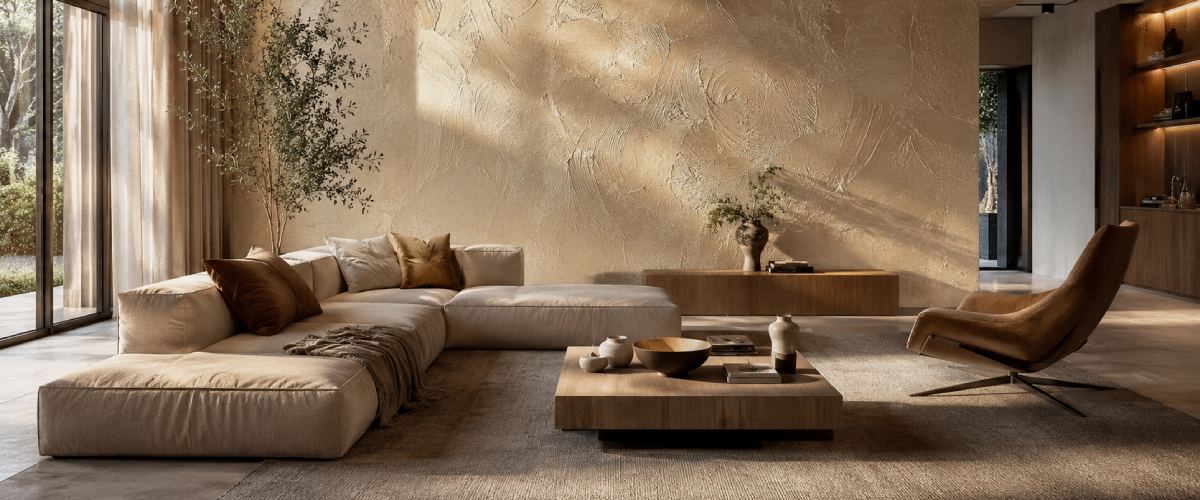
But here is what a growing number of homeowners, architects, and interior designers are quietly discovering: there is a better option. Not just a better paint, but a fundamentally different approach to finishing your walls. One that looks richer, lasts far longer, and does not require you to repaint every two to three years.
Why Regular Paint Falls Short
Wall paint is convenient and affordable upfront. But if you look at the full picture, it is not always the economical choice it appears to be.
Most emulsion paints used in Indian homes have a practical lifespan of two to four years before they start showing wear. In humid cities like Mumbai, Chennai, or Kolkata, that window is even shorter. Walls develop patches, the surface starts peeling near windows or in bathrooms, and the colour loses its freshness faster than expected.
Beyond durability, paint has another problem: it is a surface coating, not a wall material. It sits on top of the plaster underneath. When moisture builds up inside the wall from seasonal humidity, water seepage, or poor ventilation, the paint has no way to let that moisture escape. The result is bubbling, blistering, and the unmistakable dark patches that signal damp walls.
Paint gives you colour, but it gives you very little texture, depth, or character. Every painted wall in every apartment in your building looks essentially the same.
What Are the Alternatives?
When people search for paint alternatives in India, they often come across options like textured paint, wallpaper, or wood panelling. These are valid choices in certain contexts. But there is one category that tends to surprise homeowners when they first encounter it: natural lime finishes.
Lime-based wall finishes have been used in construction for thousands of years. In fact, many of the most beautiful historic buildings across India, Italy, Morocco, and the Middle East were finished with lime plaster. The material never really went away. It simply got overlooked during the era of synthetic paints and quick-fix coatings.
Today, lime finishes are seeing a strong revival, driven by a growing preference for natural materials, better indoor environments, and interiors that actually look distinct.
What Is a Lime Wall Finish?
A lime wall finish is a surface coating made from slaked lime, marble dust, natural aggregates, and sometimes natural pigments. It is applied in thin layers directly over your existing wall surface and can be finished in a variety of textures and sheens depending on the look you want.
Some of the most popular types include:
- Venetian Plaster - A smooth, polished finish with a marble-like luminosity. It reflects light beautifully and works especially well in living rooms, bedrooms, and feature walls.
- Limewash - A matte, chalky, layered effect with a soft, organic quality. It is one of the most popular finishes globally right now, particularly for homes going for a calm, warm, or minimal aesthetic.
- Stucco - A slightly textured finish with a natural stone-like quality. It adds depth without being heavy or ornate.
Each of these is a premium finish that can be applied by trained applicators, and each has a very different look from anything you can achieve with standard wall paint.
How Lime Finishes Compare to Paint for Indian Homes
Durability
A well-applied lime finish can last fifteen to twenty years or more without needing to be redone. It does not peel, it does not bubble, and it does not require touch-ups every season. Over a ten-year period, the cost often works out comparable to or better than repainting multiple times.
Breathability
This is one of the most important properties of lime, particularly in Indian homes. Lime is a naturally breathable material. It allows moisture to pass through the wall surface rather than trapping it. This means your walls stay dry even during humid monsoons, and you are far less likely to see damp patches, mould, or peeling.
For anyone living in a city like Mumbai, Cochin, or Hyderabad, this is a significant advantage over paint.
Appearance
Lime finishes have a visual quality that simply cannot be replicated by paint. They create depth and subtle variation in the surface because they are a physical material rather than a flat coating. The way they interact with light changes throughout the day. There is a warmth and richness to them that makes a room feel considered and complete.
Air Quality
Lime is naturally high in pH, which means it is antimicrobial. It resists mould and bacterial growth on the wall surface. This contributes to healthier indoor air quality, which matters for families with children, elderly members, or anyone sensitive to allergens.
Environmental Impact
Standard paints, particularly solvent-based products, contain VOCs (volatile organic compounds) that off-gas into the air you breathe indoors. Lime finishes are made from natural mineral materials and contain no synthetic resins or harmful chemicals. For homeowners thinking about sustainable choices, lime is one of the cleanest options available.
Is a Lime Finish Right for Your Home?
Lime finishes are versatile and can work in most residential settings. They are especially well-suited for:
- Living rooms and bedrooms where you want walls with real visual presence without heavy ornamentation.
- Homes in high-humidity cities where paint consistently underperforms due to moisture.
- Properties where the renovation cycle is expensive and you want a finish that holds up for years without maintenance.
- Homes with children or health-conscious families who prefer low-chemical interiors.
- Spaces where the design intent is natural, minimal, or heritage-inspired.
What About the Cost?
This is the question most people ask first, and it is a fair one.
Lime finishes cost more upfront than standard emulsion paint. The material is premium, and application requires a trained professional rather than a general house painter. Depending on the finish and the area involved, the cost per square foot will be higher than paint.
But here is the way most homeowners start to think about it once they look at the full picture: paint needs to be redone every two to three years. Each round costs you money, time, and the disruption of having painters in your home. A lime finish done well does not need to be touched for fifteen to twenty years.
When you calculate the total spend over a decade, the numbers often come very close, and in many cases the lime finish works out more economical. Factor in the better aesthetics, the durability, and the healthier living environment, and the conversation changes quite quickly.
What Limocoat Offers
Limocoat is a premium lime finish brand manufactured by JBR Coatings Pvt. Ltd. in India. Their product range includes Venetian plaster, limewash, stucco, and other natural mineral finishes designed specifically for Indian construction and climate conditions.
What sets Limocoat apart is that their finishes are formulated to perform in India's diverse climate zones, from the dry heat of Rajasthan to the coastal humidity of Maharashtra and Kerala. The brand works through a network of authorised applicators who are trained specifically in lime finish techniques, ensuring the quality of the final result.
Their finishes are available in a wide range of colours and can be customised to suit the specific design intent of your space. Whether you are renovating a flat, building a new home, or upgrading a commercial space like a restaurant or boutique hotel, Limocoat has a finish suited to the brief.
How to Get Started
If you are planning a home renovation and want to explore lime finishes as an alternative to repainting, here are a few practical steps:
First, look at reference images. Lime finishes are highly visual, and the difference between Venetian plaster, limewash, and stucco is significant. Spend some time on Instagram or Pinterest searching for the finish you are drawn to before you start any conversations with applicators.
Second, get a small area done as a sample before committing to the full space. Any good applicator will do a sample patch so you can see the actual finish on your walls in your lighting conditions.
Third, think about where lime makes most sense. You do not have to do every wall in your home. Many homeowners start with one room or one feature wall, see the result, and then expand from there.
Final Thought
Repainting your home is the obvious default, but it is not the only option. If you are already spending the time and money to refresh your walls, it is worth taking a moment to ask whether you could be getting something that lasts longer, performs better in India's climate, looks genuinely distinctive, and does not need to be redone in three years.
Lime finishes are not a niche designer indulgence. They are a practical, well-proven material that has been used in architecture for centuries, adapted for modern application, and increasingly available to homeowners across India.
The next time your walls need attention, ask yourself: why settle for paint when you could choose a finish that stands the test of time, enhances your living space, and delivers lasting value? With thoughtful consideration of your needs and the unique benefits of lime finishes, your next renovation can truly be an upgrade for years to come.