New-age cafés and restaurants are no longer designed around food alone. They are built to deliver a complete sensory experience through presentation, music, fragrance, lighting, and interiors.
That is why the usual finishes are fading out. Cold tiles, flat paint, and fake-looking laminates are being replaced by softer, warmer, more crafted surfaces.
One material leading this shift is lime plaster. With its subtle texture, quiet depth, and natural finish, it brings character to a space without trying too hard.
And it is not just a design trend. There are practical reasons why cafés and restaurants are choosing it too.
The Challenge with How Most Commercial Spaces Finish Their Walls
For decades, commercial hospitality spaces defaulted to one of a few options. Ceramic tiles for the kitchen and wet areas. Emulsion paint for dining spaces. Occasionally a feature wall with wallpaper or wood panelling for some character.
These options worked. But they came with recurring challenges.
Paint in a busy restaurant chips, scuffs, and starts looking shabby within a year. Grease and smoke settle into the surface, and regular cleaning slowly wears it down. Repainting becomes a recurring expense and a disruption to operations.
Tiles look fine, but they age quickly in style terms. Grout lines collect grime and are notoriously difficult to keep clean in a high-traffic environment. The look can feel cold and institutional, which is not exactly what you want guests to feel when they sit down for a meal.
Wallpaper peels in humid conditions, especially near kitchens and bar areas. It tears in high-traffic zones. And replacing a section never quite matches the original.
Restaurant and café owners have largely put up with these issues as the cost of doing business. But more of them are now asking a different question. What if the wall finish itself was the solution instead of the problem?
What Makes Lime Plaster Different in a Commercial Setting
Lime plaster is not new. It has been used in buildings across the Mediterranean, South Asia, and the Middle East for thousands of years. What is relatively new is its application in contemporary commercial interiors and the modern formulations that make it easier to apply and maintain.
Here is what actually makes it work well in a restaurant or café environment.
It is genuinely durable
A properly applied lime plaster finish does not chip the way paint does. It does not peel. Minor scuffs and surface marks can often be buffed out or touched up without the entire section needing to be redone. In a space where chairs scrape walls, bags brush surfaces, and staff move equipment around constantly, that kind of resilience matters.
It handles moisture without deteriorating
Restaurants are humid environments. Steam from the kitchen, condensation from drinks, moisture from cleaning, breath from a full dining room on a cold night. All of this adds up. Lime plaster is naturally breathable, which means it manages moisture dynamically rather than trapping it. This dramatically reduces the risk of mould, damp patches, and paint bubbles that plague commercial spaces.
It is naturally resistant to bacteria and mould
Lime has a high alkaline pH, which makes it inhospitable to bacteria, mould, and mildew. In a food service environment, this is not a cosmetic benefit. It is a hygiene benefit. You are not relying on chemical treatments or antimicrobial additives to keep the walls clean. The material itself does the work.
It cleans up well
A sealed lime plaster surface can be wiped down regularly without degrading. In dining areas near open kitchens or bar tops where splashes and spills are common, this is essential. The surface does not absorb liquids the way untreated finishes do, and it does not streak or discolour with regular cleaning.
The Aesthetic Case Is Just as Strong
Practicality aside, the look of lime plaster is genuinely hard to replicate with any other material.
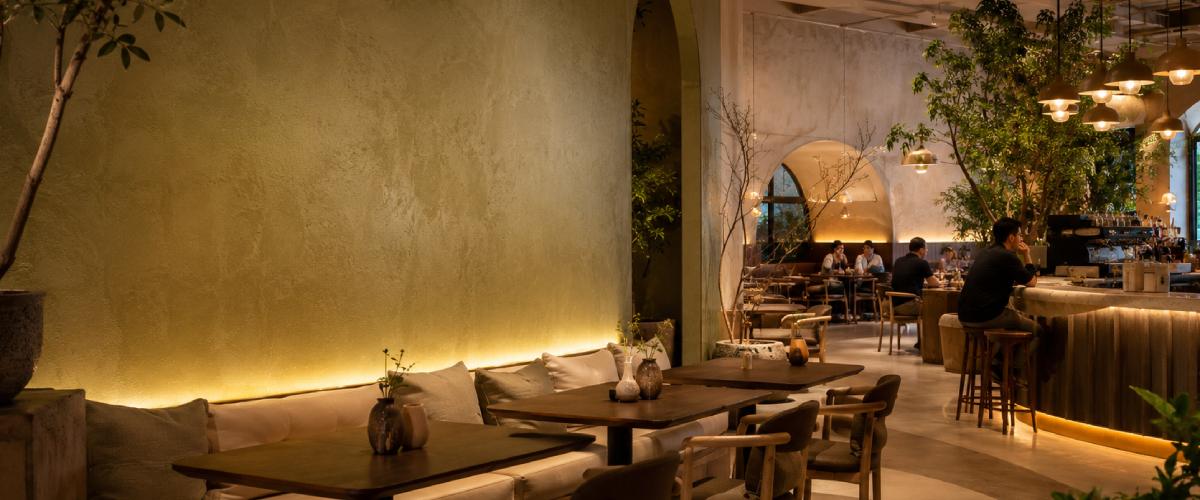
There is a depth and warmth to it that flat paint simply cannot achieve. Light moves across a lime plaster wall differently depending on the time of day, the angle of illumination, and the texture of the application. In the evening under warm pendant lighting, a lime plaster wall can make a dining space feel almost cinematic.
Restaurants and cafés have understood for a long time that the space itself is part of the product. People are not just paying for the food. They are paying for how the place makes them feel. And lime plaster contributes to that feeling in a way that is difficult to articulate but very easy to experience.
It works across a wide range of design styles. Industrial café with exposed pipes and concrete floors? Lime plaster fits. Soft, romantic fine dining space? Lime plaster fits. Casual neighbourhood bistro with a warm earthy palette? Lime plaster fits. It is a material that does not fight the rest of the design. It supports it.
The variety of finishes available today also helps. From very smooth and refined to heavily textured and rustic, lime plaster can be applied in ways that suit completely different aesthetics. Colour options have expanded significantly too, moving far beyond the traditional white and off-white palette into warm terracottas, soft greys, deep charcoals, and everything in between.
The Instagram Factor (It Is Real and It Matters)
This might sound superficial but it is genuinely relevant to any café or restaurant owner thinking about their space.
Lime plaster photographs beautifully. The texture, the warmth, the way it interacts with light all translate extremely well on a phone camera. Guests take photos of food against these walls. They take selfies. They post the space itself.
In an era where a significant portion of a restaurant's marketing happens organically through guest-generated content, having a space that people want to photograph is a legitimate competitive advantage. And a well-executed lime plaster interior is exactly that kind of space.
Several well-known cafés in cities like Mumbai, Bengaluru, and Delhi have seen their social media presence genuinely boosted by the aesthetic of the space. The walls were part of that story.
Longevity and Cost Over Time
The upfront cost of lime plaster is higher than emulsion paint. There is no point pretending otherwise. But the comparison changes considerably when you think in years rather than months.
A lime plaster finish applied properly can last ten to fifteen years with minimal maintenance. Paint in a busy commercial space might need touching up every one to two years and a full repaint every three to five. Factor in the labour, the disruption to operations, the material cost, and the cumulative expense of repeated repaints, and lime plaster often works out cheaper over the life of the space.
There is also the brand value angle. A restaurant that looks well-crafted and considered reads as more premium to guests. That perception translates into pricing power, repeat visits, and recommendations. The interior is an investment in how people perceive and talk about the place.
What Restaurant and Café Owners Should Know Before Making the Switch
If you are considering lime plaster for your space, a few things are worth knowing upfront.
Application requires skill. This is not a job for a general contractor who has never worked with lime. The technique, the layering, the timing, and the sealing all matter enormously. The quality of the final finish depends heavily on the applicator's experience. Work with a specialist brand or applicator who has done commercial spaces before.
Sealing is important in food service environments. The right breathable sealer protects the surface from oil, grease, and food splatter without compromising the material's natural properties. Make sure this is part of the specification.
Plan the application during a closure period. Lime plaster needs time to dry and cure properly. If you are refurbishing an existing space, build the application and curing time into your renovation schedule.
Conclusion
The shift toward lime wall finishes in restaurants and cafés is not a passing trend. It is driven by real performance advantages in tough commercial environments, combined with an aesthetic quality that genuinely elevates a space.
For hospitality owners who are tired of repainting every couple of years, dealing with mould and damp, and looking at walls that start looking tired six months after opening, lime plaster is worth taking seriously.
It lasts longer. It looks better. It ages gracefully. And in a business where first impressions matter enormously, that is a combination that is hard to argue with.
Thinking about lime plaster for your restaurant or café? Get in touch with the Limocoat team to explore finishes, colours, and the right applicator for your commercial project.